
We can provide handler/canine teams trained to locate historical human remains, adding another layer of confidence to your archaeology surveys
Our canines are trained to recognize the full spectrum of human decomposition odor; from a few hours ago, or days ago, to a few decades ago, to abandoned pioneer graves in the mid-1800's, to native-American burial mounds which may be hundreds or thousands of years old.
It's not magic - scientific research on the decomposition of the human body points to nearly 500 volitile organic compounds that remain in the soil long after the body has skeletonized (A. Vaas et al 2008, Carabello 2014).
Our detection capabilities take less time than traditional Phase 1 methods and can verify the presence or absence of human remains, adding another layer of confidence to your surveys. Think of it as a pedestrian survey with a hunting dog; a hunting dog that's sniffing for graves that may be right under your feet. Just because you can't see them doesn't mean they aren't there.
Our handler/canine teams are non-invasive and non-destructive. Depending on the weather conditions, the ground cover, and the terrain, we can effectively and efficiently cover a few acres in less than an hour, and considerably more in less than a day.
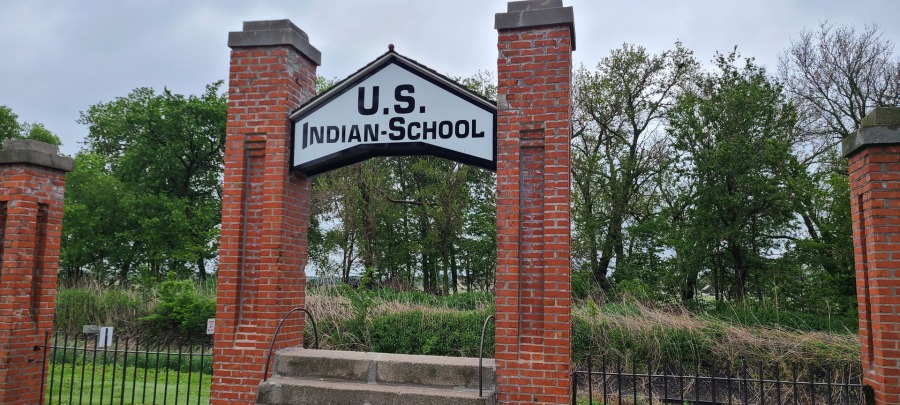
The image below is of the gate (stile) in Genoa, Nebraska which sits next to the train tracks where the indigenous children got off of the train after being abducted from their families and homelands. They were forced to learn English and work and study in a White dominated school to "help" them assimilate into the white culture. Some of the children were as young as four.
We were tasked with locating the cemetery where they were buried after succumbing to disease, and sometimes, suicide.
This is data from an archaeology survey of a mound site in the Midwest. It was particularly challenging for the dogs because the prairie grasses were over four feet tall, it was very hot, very humid, and raining off and on.

This is Storm early in her training to locate prehistoric native burials. Her behaviors were identical to the behaviors she exhibited on much more recent human decomposition. Storm was recognized by NASAR as the 2009 Search and Rescue dog of the year

 Print
Print 